
Questo Blog è dedicato alla musica, alla chitarra classica, alla musica contemporanea. This Blog is devoted to contemporary, avangarde guitar's music.
Visualizzazione post con etichetta Geoffrey Morris. Mostra tutti i post
Visualizzazione post con etichetta Geoffrey Morris. Mostra tutti i post
domenica 30 settembre 2012
sabato 29 settembre 2012
Interview with Geoffrey Morris, fourth part

Italian Translation
Please tell us five essential records, to have always with you .. the classic five discs for the desert island ...
Frank Sinatra and the Count Bassie Band Live at the Sands
Ives Ensemble plays Morton Feldman TRIO
Anything with Jose Miguel Moreno on it
Anything with Paul O’dette on it
U2 The Josua Tree
What are your five favorite scores?
Franco Donatoni Algo
Morton Feldman The Possibility of New Work
Vaundry de Saizenay manuscript
Sylvano Bussotti Ultima Rara
Maurizio Pisati Sette Studi
Whith who would you like to play? What kind of music do you listen to usually?
I guess when considering who I would most like to play with I think I would always be considering from whom could I learn the most? Probably Jose Miguel Moreno. Presently I listen almost exclusively to early music but my listening habbits go in cycles.
Your next projects? When we will see you playing in Italy?
I am currently mastering a CD of Latin songs with the English tenor Tyrone Landau and a CD of Australian contemporary music which is a compilation of radio recordings. Andrea Tacchi is currently making me an alto guitar so I may come to Italy early in the new year to pick it up but it terms of concerts I’m not sure. I have a young family so at present I travel very little.
The last question …. the Blog is read by several students .. any good advices to give them?
Listen very widely, try to find a new avenue to explore in your repertoire and in terms of technique work towards the most tension free approach. Playing as much chamber music as possible is crucial though. Not only will it sharpen your performance skills in an absolutly essential manner but will also put you in contact with working musicians!
The last question …. the Blog is read by several students .. any good advices to give them?
Listen very widely, try to find a new avenue to explore in your repertoire and in terms of technique work towards the most tension free approach. Playing as much chamber music as possible is crucial though. Not only will it sharpen your performance skills in an absolutly essential manner but will also put you in contact with working musicians!
Thank you very much!
 Etichette:
fourth,
Geoffrey Morris,
interview
Etichette:
fourth,
Geoffrey Morris,
interview
Intervista a Geoffrey Morris, quarta parte
English Version
Per favore ci dica i suoi cinque dischi essenziali, da avere sempre con lei .. i cinque dischi classici per l'isola deserta...
Frank Sinatra and the Count Bassie Band Live at the Sands
Ives Ensemble plays Morton Feldman TRIO
Qualsiasi cosa con Jose Miguel Moreno
Qualsiasi cosa con Paul O'dette
U2 The Josua Tree
Quali sono i Suoi cinque spartiti preferiti?
Franco Donatoni Algo
Morton Feldman The Possibility of New Work
Vaundry de Saizenay manuscript
Sylvano Bussotti Ultima Rara
Maurizio Pisati Sette Studi
Con chi le piacerebbe suonare? Che genere di musica ascolta di solito?
Quando penso ai musicisti con cui mi piacerebbe di più suonare considero sempre da chi di loro potrei imparare di più Probabilmente Jose Miguel Moreno. Al momento io ascolto quasi esclusivamente “early music” ma le mie abitudini di ascolto cambiano ciclicamente.
I Suoi prossimi progetti? Quando la vedremo suonare in Italia?
Al momento sto registrando un CD di canzoni latine col tenore inglese Tyrone Landau ed un CD di musica contemporanea australiana che è una compilation di incizioni radiofoniche. Andrea Tacchi mi sta preparando una chitarra contralto così potrei essere in Italia nei primi mesi del prossimo anno per andarla a prendere ma per quanto riguarda la possibilità di concerti non ho nulla di sicuro. Io ho una famiglia giovane e così viaggio molto poco.
L'ultima domanda.. il Blog è letto da molti studenti.. ha qualche buon consiglio da dare loro?
Di ascoltare in modo esteso, di tentare di trovare una strada nuova per esplorare ilo loro repertorio e per quanto riguarda la tecnica di cercare l’approccio il più possibile libero da qualsiasi tensione. E’ importante suonare più musica da camera possibile. Non solo affinerà al massimo le vostre capacità musicali ma verrete in contatto musicisti che suonano sempre!
Etichette:
Geoffrey Morris,
intervista,
quarta
venerdì 28 settembre 2012
Interview with Geoffrey Morris, third part

Italian Translation
I have realy enjoyed your recording about the guitar music by Aldo Clementi, how did it happens to you to record those music and how is your relationship between Mode Records?
My wife was studying lute with Paul Beier in Milano during 2001 and I came over and spent three months with her in Italy. I had played many works by Clementi both chamber and guitar pieces and wanted to play to him while in Europe. Gabriele Bonomo heard my CD ‘In Flagranti’ and was instrumental in putting me in touch with Aldo and helping me commission him for a new solo work. When I returned to Australia I recorded the solo peices on the back of other more commercial projects through the Australian Broadcasting Commission. Daryl Buckley from Elision was very helpful and he organised the chamber recordings including a piece Elision had commissioned from Aldo back in 1992 and he also took the recording to Mode.
Aldo is a masterful composer and such a fantastic ‘thinker’ on music. Many of his views on modern music I share. Soon I have an article on his music coming out in Contemporary Music Review for those interested.
I have, sometimes, the feeling that in our times music’s history flows without a particular interest in its chronological course, in our discoteque before and after, past and future become interchangeable elements, shall this be a risk of a uniform vision for an interpreter and a composer? The risk of a musical "globalization"?
I don’t think we are really in risk of a kind of artistic ‘globalization’ in our field because it is already so far outside the mainstream of popular music practice. In some ways being almost irrelevant or at best hidden from the wider musical public allows a certain freedom in terms of direction, interpretation etc. On the plus side things like the internet have made communication so easy and this can be great in the exchange of ideas and especially so in education. Growing up in Melbourne meant that I very rarely got to see top artists perform live but now I can just send my students to Youtube to hear and see great players.
Luciano Berio writes "the preservation of the past has a negative sense, as it becomes a way of forgetting music. The listener will get an illusion of continuity that allows you to select what seems to confirm that same continuity and censor everything that seems disturbino”, What role can take music and contemporary composers in this context?
In terms of programming recitals I now prefer the idea of mixing different musical era in a recital because here in Australia the audience for specialist new music events has really dwindled for notated contemporary music but has grown a lot for improvised music. I think by very careful programming an artist can illuminate the musical continuity that Berio spoke of. In terms of expanding our knowledge of disturbing elements to the musical cannon, those elements can be the most exciting areas to explore but this takes knowledge of performance practice, musical history and the ability to be accross the repertoire in a way that was previously not required by many performers.
What do you think about the discographic market crisis, with the transition to digital downloading in mp3 and all this new scenario?
Well mp3 could be a good thing but I still really like the older format in terms of the information in programme notes and the artistic aspect in packaging the disc. I understand the issues with illegal downloading though and who knows what the result of this will be long term.
to be continued
Etichette:
Geoffrey Morris,
interview,
third
Intervista a Geoffrey Morris, terza parte
English Version
Ho veramente apprezzato la sua incisione della musica di chitarra di Aldo Clementi, come le è successo di registrare quelle musiche e come sono i rapporti tra lei e la Mode Records?
Mia moglie stava studiando liuto con Paul Beier in Milano nel 2001 ed io venni su e passai tre mesi con lei in Italia. Io avevo suonato molti lavori de Clementi sia da camera che pezzi per chitarra, ed avevo voluto suonare la sua musica mentre ero in Europa. Gabriele Bonomo aveva ascoltato il mio CD “In Flagranti” e mi aiutò a mettermi in contatto con Aldo ed aiutarmi per farmi commissionare un nuovo lavoro solista. Quando io ritornai ad Australia registrai il pezzo da solista assieme ad altri progetti più commerciali attraverso la Australian Broadcasting Commission. Daryl Buckley di Elision fu di grande aiuto organizzando le incisioni della musica da camera incluso un pezzo che Elision aveva commissionato da Aldo nel 1992 e segnalando l'incisione a Mode Records.
Aldo è un compositore eccezionale e un fantastico 'pensatore' musicale. Condivido molte delle sue visioni sulla musica moderna. Per chi fosse interessato presto uscirà un mio articolo sulla sua musica su Contemporary Music Review.
Ho, a volte, la sensazione che nella nostra epoca la storia della musica scorra senza un particolare interesse per il suo decorso cronologico, nella nostra discoteca-biblioteca musicale il prima e il dopo, il passato e il futuro diventano elementi intercambiabili, questo non può comportare il rischio per un interprete e per un compositore di una visione uniforme? Di una “globalizzazione” musicale?
Non penso che corriamo veramente qualche rischio di una “globalizzazione artistica” nel nostro campo perché è già da tempo al di fuori della corrente della musica popolare. In certi casi essere quasi irrilevanti o meglio ancora nascosti all’attenzione del pubblico musicale permette una certa libertà di direzione, di interpretazione ecc. Tra le cose positive Internet ha di fatto reso la comunicazione facilissima e questo è fondamentale nello scambio di idee così come per l'istruzione. Crescere a Melbourne vuole dire che molto raramente ho avuto la possibilità di vedere dal vivo artisti di fama ma ora io posso invitare i miei studenti a sentire e vedere i grandi musicisti su Youtube.
Luciano Berio ha scritto “la conservazione del passato ha un senso anche negativo, quanto diventa un modo di dimenticare la musica. L’ascoltatore ne ricava un’illusione di continuità che gli permette di selezionare quanto pare confermare quella stessa continuità e di censurare tutto quanto pare disturbarla”, che ruolo possono assumere la musica e i compositori contemporanei in questo contesto?
Per quanto riguarda la programmazione dei miei recitals io apprezzo molto l'idea di mescolare tra loro ere musicali diverse perché qui in Australia il pubblico che segue gli eventi della nuova musica è molto diminuito per quanto riguarda la musica contemporanea “annotata” mentre è cresciuto molto per quanto riguarda la musica improvvisata. Io penso che un artista con un programma molto accurato posso illuminare la continuità musicale della quale parlava Berio. Gli elementi di “disturbo” rispetto al canone musicale classico possono essere le aree più eccitanti da esplorare ma questo richiede una perfetta padronanza tecnica, la conoscenza della loro storia musicale e l'abilità di essere trasversali al repertorio in un modo che mai prima era stato richiesto agli esecutori.
Come vede la crisi del mercato discografico, con il passaggio dal supporto digitale al download in mp3 e tutto questo nuovo scenario? Tutta questa passiva tendenza ad essere aggiornati e di possedere tonnellate di mp3 che difficilmente potranno essere ascoltati con la dovuta attenzione non comporta il rischio di trascurare la reale assimilazione di idee e di processi creativi?
Gli mp3 potrebbero essere una buona cosa ma io amo ancora il vecchio formato sia per le informazioni contentute nelle note allegate sia per l'aspetto artistico della confezione del disco. Capisco tuttavia le questioni legate allo scarico illegale e che sa quale sarà il risultato di questo nel lungo termine.
continua domani
Etichette:
Geoffrey Morris,
intervista,
terza
giovedì 27 settembre 2012
Interview with Geoffrey Morris, second part

Italian Translation
What does improvisation mean for your music research? Do you think it’s possibile to talk about improvisation for classical music or we have to turn to other repertories like jazz, contemporary music, etc.?.?
I use improvisation a lot in my teaching and I am very interested in improvisation in early music but I am not so interested in improvisation in new music or ‘free’ music only because I have heard a lot of it and it seems a field in which doing it is a lot more interesting than listening to it in most cases. Having said that I love the CD of Pat Methany and Derek Bailey live together. But coming back to early music I love the use of improvisation or division as it now rememerging amongst lutenists and others. It allows for a very personal performance.
Listening to your music, I noticed the quiet serenity with which you approach your instrument regardless of repertoire, from whom you are playing, the composer, the instrument that you use always showing full control both technical and emotional, how much important is to work on technique to achieve this level of "security"?
The guitar is a very ‘technique’ heavey isntrument. You need to be on top of and always open to development. I don’t think the technique I now have is even remotely related to the technique i learnt from my teachers. It comes from playing chamber music...having a good conductor point out things about your playing...projecting within a mixed ensemble...accompanying a good singer. These things push you. There are some guitarist in Australia who are completly obsessed with technique though. To the point of a kind of vanity overiding musical expression and purpose. Anyway if I have a goal in technique it is to be able to change and adapt to the repertoire and the instrument I am playing.
It Seems to me that there is a small music scene about classical guitarists dedicated to an innovative and contemporary repertoire, as well as you come to my mind the names of Marco Cappelli, David Tanenbaum, David Starobin, Elena Casoli, Emanuele Forni, Marc Ribot who played John Zorn music ... shall I speak about a music scene? Are you in contact between each other or operate independently? Are there other guitarists you know and that you can suggest us that they move on these musical routes?
I have had a lot of contact with Elena Casoli. In fact I organised a concert for her here in Melbourne. It was great and she is a terrific player. Seth Josel is a great player who works mainly with the electric guitar and Jurgen Ruck of course. There are lots of good players of new music now which is as it shoud be. Because I am on the other side of the planet though means I am very isolated which is at times a big problem. My new music practice in Australia has nothing to do with the guitar scene here. In fact I lead two quite seperate lives!
You have played with Maurizio Pisati for his Teathre of Dawn, what do you remember about that experience?
I have been playing Maurizio’s music since 1993 when he composed Dercialet for Elision. I have played his sette studio, arrangements of music by Scarlatti and Sciarino and heaps of other chamber works three with film accompaniment. He is a really interesting composer and I think one of the few who have really combined compositional technique and skill with a truly indiginous understanding of the gutiar. His “Theatre of Dawn” is a wonderful work and needs to be presented in a major festival and given some real support and i believe the audience for the work could be excellent.
Listening to your music, I noticed the quiet serenity with which you approach your instrument regardless of repertoire, from whom you are playing, the composer, the instrument that you use always showing full control both technical and emotional, how much important is to work on technique to achieve this level of "security"?
The guitar is a very ‘technique’ heavey isntrument. You need to be on top of and always open to development. I don’t think the technique I now have is even remotely related to the technique i learnt from my teachers. It comes from playing chamber music...having a good conductor point out things about your playing...projecting within a mixed ensemble...accompanying a good singer. These things push you. There are some guitarist in Australia who are completly obsessed with technique though. To the point of a kind of vanity overiding musical expression and purpose. Anyway if I have a goal in technique it is to be able to change and adapt to the repertoire and the instrument I am playing.
It Seems to me that there is a small music scene about classical guitarists dedicated to an innovative and contemporary repertoire, as well as you come to my mind the names of Marco Cappelli, David Tanenbaum, David Starobin, Elena Casoli, Emanuele Forni, Marc Ribot who played John Zorn music ... shall I speak about a music scene? Are you in contact between each other or operate independently? Are there other guitarists you know and that you can suggest us that they move on these musical routes?
I have had a lot of contact with Elena Casoli. In fact I organised a concert for her here in Melbourne. It was great and she is a terrific player. Seth Josel is a great player who works mainly with the electric guitar and Jurgen Ruck of course. There are lots of good players of new music now which is as it shoud be. Because I am on the other side of the planet though means I am very isolated which is at times a big problem. My new music practice in Australia has nothing to do with the guitar scene here. In fact I lead two quite seperate lives!
You have played with Maurizio Pisati for his Teathre of Dawn, what do you remember about that experience?
I have been playing Maurizio’s music since 1993 when he composed Dercialet for Elision. I have played his sette studio, arrangements of music by Scarlatti and Sciarino and heaps of other chamber works three with film accompaniment. He is a really interesting composer and I think one of the few who have really combined compositional technique and skill with a truly indiginous understanding of the gutiar. His “Theatre of Dawn” is a wonderful work and needs to be presented in a major festival and given some real support and i believe the audience for the work could be excellent.
to be continued
Etichette:
Geoffrey Morris,
interview,
second
Intervista a Geoffrey Morris, seconda parte
English Version
Quale significato ha l’improvvisazione nella sua ricerca musicale? Si può tornare a parlare di improvvisazione in un repertorio così codificato come quello classico o bisogna per forza uscirne e rivolgersi ad altri repertori, jazz, contemporanea, etc?
Io uso molto l’improvvisazione nel mio insegnamento ed io sono molto interessato all'improvvisazione nella “early music” ma non ne sono così interessato nella nuova musica o nella 'free music' unicamente perché ne ho ascoltata molta e mi sembra un campo nel quale suonare è molto più interessante che ascoltare. Devo anche dire che amo il CD dove Pat Metheny e Derek Bailey suonano insieme. Ma ritornando alla “early music” amo l'uso di improvvisazione o della divisione come sta ora riemergendo tra i liutisti ed altri musicisti. Lascia spazio a una performance molto personale.
Ascoltando la sua musica ho notato la tranquilla serenità con cui lei si approccia allo strumento indipendentemente dal repertorio, da con chi sta suonando, dal compositore, dallo strumento che lei adopera dimostrando sempre un totale controllo sia tecnico che emotivo, quanto è importante il lavoro sulla tecnica per raggiungere a questo livello di “sicurezza”?
La chitarra è uno strumento “tecnicamente pesante”. Devi sempre essere al massimo della forma e sempre aprirti a nuovi sviluppi. Non penso che la tecnica che ora ho possa rifersi anche di lontano alla tecnica che ho imparato dai miei insegnanti. Viene dal suonare musica da camera ... significa .. avere un buon direttore che segnali delle cose sul tuo modo di suonare ... proiettare il suono all'interno di un ensemble misto ... accompagnare un buon cantante. Queste cose ti spingono. Ci sono alcuni chitarristi in Australia che sono totalmente ossessionati dal pensiero della tecnica. Al punto di arrivare a una specie di forma di vanità in grado di superare qualsiasi espressione musicale e scopo. In ogni modo se io ho un obiettivo nella tecnica è quello di essere capace di cambiare ed adattarmi al repertorio ed allo strumento che sto suonando.
Mi sembra che si sia formata una una piccola scena musicale con chitarristi classici dedicati ad un repertorio innovativo e contemporaneo, mi vengono così in mente i nomi di Marco Cappelli, David Tanenbaum, David Starobin, Elena Casoli, Emanuele Forni, Marc Ribot che ha suonato le musiche di John Zorn ... è possibile parlare di una scena musicale? Siete in contatto tra voi o ciascuno opera indipendentemente? Ci sono gli altri chitarristi che Lei consoce e che può suggerirci che operano su questi percorsi musicali particolari?
Io ho avuto molti contatti con Elena Càsoli. Ho organizzato un concerto per lei qui a Melbourne. E’ stata grande e lei è una musicista eccezionale. Seth Josel è un grande chitarrista che suona principalmente con la chitarra elettrica e certo anche Jürgen Ruck è molto bravo. Ci sono ora diversi bravi interpreti di musica nuova come è giusto che sia. Poichè però io sono sull'altro lato del pianeta mi ritrovo molto isolato il che è a volte un grosso problema. La mia pratica di musica nuova in Australia non ha niente per fare con la scena chitarristica di qui. Infatti io conduco due vite completamente separate!
Lei ha suonato con Maurizio Pisati per il suo Teathre di Dawn, cosa ricorda di quella esperienza?
Suono la musica di Maurizio dal 1993 quando lui compose Dercialet per Elision. Io ho suonato i suoi Sette Studi, le trascrizioni e gli arrangiamenti di Scarlatti e Sciarino e un mucchio di altra musica da camera tre dei quali con accompagnamento cinematografico. Lui è un compositore veramente interessante ed io penso uno dei pochi che hanno saputo unire tra loro tecnica compositiva ed abilità strumentale in modo veramente innovativo e comprensivo della chitarra. Il suo “Theatre of Dawn” è un lavoro meraviglioso e ha bisogno di essere presentato in un festival importante con un vero appoggio, sono sicuro che i riscontri da parte del pubblico sarebbero eccellenti.
continua domani
Etichette:
Geoffrey Morris,
intervista,
seconda
mercoledì 26 settembre 2012
Interview with Geoffrey Morris, first part

Italian Translation
The first question is always the classic one: how does it start your love and interest for guitar and what instruments do you play or have you played?
Like so many guitarists of my generation I was first attracted to the guitar through Rock music. In fact I played rock or jazz up until my 18th birthday and only then did I have the chance to study classical guitar. I think I didn’t learn to read music until i was 16 years old. I did study piano as a young child but I hated it. These days I play baroque guitar, 19th century guitar, modern classical guitar and very occassionally, the electric guitar.
What was your musical training, with which teachers have you studied and what impression they left in your music?
I was very lucky to study at the Victorian College of the Arts with Jochen Schubert who was a classical guitarist who emigrated from Germany to Australia in the late 1960’s. He gave me a real passion for exploring the instruments repertoire in a very broad way and he had a much better attitude to new music than most classical guitarists. Once I finished my degree I went to Europe and took lessons in new music from Stefano Cardi in Rome and Magnus Andersson in Stockholm. They were very different musicians and it was quite a culture shock for a 21 year old. I think in many ways I have learnt the most though through being an avid listener of recorded music of all genres and by being a constant researcher of texts written on the guitar from the renaissance on.
How did stat your interest about the contemporary repertoire, and what are the stylistic currents in which you recognize yourself most?
As a student Leo Brouwer’s studies were a great eye and ear opener. From there I went to the recodings of Julian Bream particularly the Royal Winter Music by Hans Werner Henze. After a few years I managed to start working with the Elision Ensemble and this brought me in contact with the music of Franco Donatoni and of the English modernists such as Brian Ferneyhough. I’m not sure in what ‘current’ I recognise myself although I certainly feel very far removed from the new romantics or at least those composers who seem to so well exploit the growing gulf between new music and the audience by writing psuedo- pop music.
Berio in his essay "A remembrance to the future," wrote: ".. A pianist who is a specialist about classical and romantic repertoire, and plays Beethoven and Chopin without knowing the music of the twentieth century, it is also off as a pianist who is specialist about contemporary music and plays with hands and mind that have never been crossed in depth by Beethoven and Chopin. " You play both traditional classical and contemporary repertoire ... do you recognize yourlsef in these words?
Early on in my playing career I only played new music. I think it is really bad for performers and now my interests are so broad that it can at times lead to a kind of paralysis through too many choices. I no longer want to play recitals which are only new music at least not at the present. The idea of study, research and following a consistent musical journey is in many ways more improtant to me than performance. I think the idea of playing a broad repertoire represents a desire on the part of the artist to experience the full history and breadth of their repertoire.
Let’s talk about marketing. How much do you think it’s important for a modern musician? I mean: how much is crucial to be good promoters of themselves and their works in music today?
How did stat your interest about the contemporary repertoire, and what are the stylistic currents in which you recognize yourself most?
As a student Leo Brouwer’s studies were a great eye and ear opener. From there I went to the recodings of Julian Bream particularly the Royal Winter Music by Hans Werner Henze. After a few years I managed to start working with the Elision Ensemble and this brought me in contact with the music of Franco Donatoni and of the English modernists such as Brian Ferneyhough. I’m not sure in what ‘current’ I recognise myself although I certainly feel very far removed from the new romantics or at least those composers who seem to so well exploit the growing gulf between new music and the audience by writing psuedo- pop music.
Berio in his essay "A remembrance to the future," wrote: ".. A pianist who is a specialist about classical and romantic repertoire, and plays Beethoven and Chopin without knowing the music of the twentieth century, it is also off as a pianist who is specialist about contemporary music and plays with hands and mind that have never been crossed in depth by Beethoven and Chopin. " You play both traditional classical and contemporary repertoire ... do you recognize yourlsef in these words?
Early on in my playing career I only played new music. I think it is really bad for performers and now my interests are so broad that it can at times lead to a kind of paralysis through too many choices. I no longer want to play recitals which are only new music at least not at the present. The idea of study, research and following a consistent musical journey is in many ways more improtant to me than performance. I think the idea of playing a broad repertoire represents a desire on the part of the artist to experience the full history and breadth of their repertoire.
Let’s talk about marketing. How much do you think it’s important for a modern musician? I mean: how much is crucial to be good promoters of themselves and their works in music today?
Well I’m terrible with this. The website I have was part of a prize I was awarded but I’m sure that self-promotion is probably crucial at least to those who are trying to perform all the time. There will be musicians who are better at promotion than playing! But I guess that we have to hope that quality wins out in the end.
to be continued
Etichette:
first,
Geoffrey Morris,
interview
Intervista a Geoffrey Morris, prima parte
English Version
La prima domanda è quella classica di sempre: come è iniziato il suo amore e interesse per chitarra e che strumenti suona o ha suonato?
Come così molti chitarristi della mia generazione io prima fui attirato alla chitarra per via della musica rock. Infatti ho suonato rock e jazz fino al mio diciottesimo compleanno e solamente dopo ho avuto l'occasione per studiare chitarra classica. Io penso di non aver imparato a leggere la musica finché non ho compiuto i sedici anni. Ho studiato pianoforte da bambino ma lo odiavo. Adesso suono chitarra barocca, chitarra del XIX secolo, chitarra classica e moderna e molto occasionalmente la chitarra elettrica.
Quale è stata la sua formazione musicale, con quali insegnanti ha studiato e che impronta hanno lasciato nella sua musica?
Sono stato molto fortunato a studiare al Victorian College of the Arts con Jochen Schubert che era un chitarrista classico emigrato dalla Germania ad Australia nei tardi anni ‘60. Lui mi diede una passione reale per esplorare in modo ampio il repertorio dello strumento e in più aveva un atteggiamento molto migliore nei confronti della “new music“ rispetto alla maggior parte dei chitarristi classici. Una volta preso il diploma andai in Europa e presi lezioni di “new music” da parte di Stefano Cardi a Roma e Magnus Andersson a Stoccolma. Loro erano musicisti molto diversi e fu quasi uno shock culturale per un giovane di ventun anni. Io penso di aver imparato molto con il fatto di essere un ascoltatore avido di musica registrata di tutti i generi e un ricercatore assiduo di partiture sulla chitarra dal rinascimento in su.
Come è iniziato il suo interesse per il repertorio contemporaneo, e quelli sono le correnti stilistiche nelle quale Lei si riconosce di più?
Da studente gli Studi di Leo Brouwer mi furono di grande stimolo per aprire occhi e orecchie. Da là continuai con le registrazioni di Julian Bream in particolare con Royal Winter Music di Hans Werner Henze. Dopo che alcuni anni riuscii a cominciare a lavorare con l'Elision Ensemble e questo mi portò in contatto con la musica di Franco Donatoni e dei modernisti inglesi come Brian Ferneyhough. Io non sono sicuro di quale 'corrente' io mi riconosco anche se certamente mi sento molto lontano dal nuovo romanticismo o almeno da quei compositori che sembrano sfruttare così bene la crescente connessione tra musica nuova ed il pubblico scrivendo musica pseudo-popolare.
Berio nel suo saggio “Un ricordo al futuro” ha scritto: “.. Un pianista che si dichiara specialista del repertorio classico e romantico, e suona Beethoven e Chopin senza conoscere la musica del Novecento, è altrettanto spento di un pianista che si dichiara specialista di musica contemporanea e la suona con mani e mente che non sono stati mai attraversati in profondità da Beethoven e Chopin.” Lei suona sia un repertorio tradizionalmente classico che il repertorio contemporaneo … si riconosce in queste parole?
Ho iniziato presto nella mia carriera di esecutore a suonare solo new music. Penso che questo sia veramente sbagliato per un interprete ed ora i miei interessi sono così tanti e tali che possono portare a qualche forma di paralisi a causa delle troppe possibilità di scelta. Non voglio più suonare recitals nei quali ci sia solo new music almeno non per il presente. L'idea di studiare, ricercare e seguire un costante percorso musicale è in molti casi più importante per me che la semplice performance. Io penso che l'idea di voler suonare un ampio repertorio rappresenti un desiderio da parte dell'artista di sperimentare l’intera storia e ampiezza del repertorio del suo strumento.
Parliamo di marketing. Quanto pensa che sia importante per un musicista moderno? Intendo dire: quanto è determinante essere dei buoni promotori di se stessi e del proprio lavoro nel mondo della musica di oggi?
Bene, io in questo sono terribile. Il mio sito web faceva parte di un premio che mi fu dato ma io sono sicuro che l’auto-promozione probabilmente sia un fattore cruciale per coloro che cercano di suonare sempre. Ci saranno musicisti più bravi nel promuoversi che non nel suonare! Ma mi auguro che alla fine la qualità vinca sempre.
continua domani ...
Etichette:
Geoffrey Morris,
intervista,
prima
martedì 25 settembre 2012
Review of Clementi Works with Guitar di Geoffrey Morris ELISION Ensemble, Mode Records 2007

Italian Translation
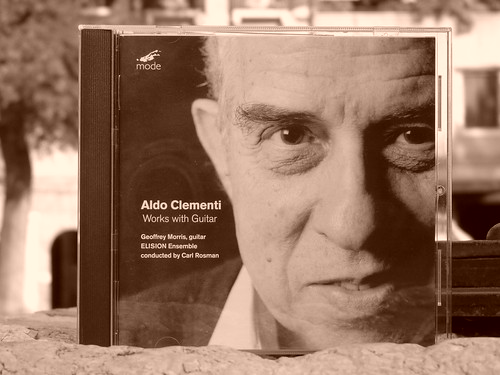
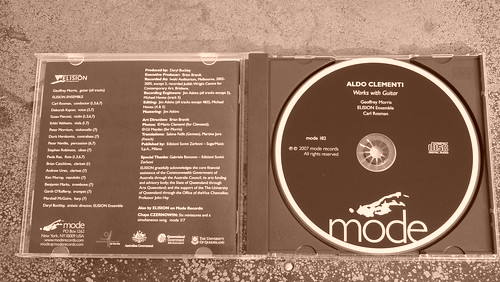
We talked about the Australian guitarist Geoffrey Morris during the interview with Maurizio Pisati as involved in his Teathre of a Dawn’s project, now we meet him again in this monographic CD released on Mode Records in 2007, entirely devoted to the music for guitar by Aldo Clementi, Genoese composer born in 1925, pupil of Goffredo Petrassi and friend of Bruno Maderna. The compositions recorded here cover a span of 25 years, from 1978's Fantasia su frammenti di Michelangelo Galilei, originally for lute and revived here for guitar by permission of Clementi, to the Otto Variazioni of 2002, written and dedicated to the same Morris. Only those here cited, along with Twelve Variations composed in 1992, are for solo guitar while the others on the disc like Serenade of 1988, Albumblatt of 1995, CAG 1993 and The Plaint of 1992 are provide for mixed ensemble.
Musically, listening to this record is not the simplest thing and it’s necessari to approach it step by step, slowly letting that the delicate structures of the music of Clementi and the skills of the musicians conquer us, little by little, then their poetry and their spatiality will speak clearly outlining a new world of sound, made of calm interwoven sound and subtle dynamics. Mode Records to be congratulated for the fine quality of the recording and the handsome 24-page booklet that accompanies it, beautiful and intense the black and white photo on the cover of Clementi.
Musically, listening to this record is not the simplest thing and it’s necessari to approach it step by step, slowly letting that the delicate structures of the music of Clementi and the skills of the musicians conquer us, little by little, then their poetry and their spatiality will speak clearly outlining a new world of sound, made of calm interwoven sound and subtle dynamics. Mode Records to be congratulated for the fine quality of the recording and the handsome 24-page booklet that accompanies it, beautiful and intense the black and white photo on the cover of Clementi.
Etichette:
Geoffrey Morris,
Mode Records,
review
Recensione di Clementi Works with Guitar di Geoffrey Morris ELISION Ensemble, Mode Records 2007
English Version
Abbiamo parlato del chitarrista australiano Geoffrey Morris in occasione dell’intervista a Maurizio Pisati, in quanto coinvolto nel suo progetto Teathre of a Dawn, lo ritroviamo in questo cd monografico uscito per la Mode Records nel 2007, interamente dedicato alle musiche di per chitarra di Aldo Clementi, compositore genovese classe 1925, allievo di Goffredo Petrassi e amico di Bruno Maderna.
Le composizioni qui incise coprono un arco temporale di 25 anni, dal 1978 della Fantasia su frammenti di Michelangelo Galilei, originariamente per liuto e qui riproposta con l’autorizzazione di Clementi per chitarra, alle Otto Variazioni del 2002, scritte e dedicate allo stesso Morris, delle quali solo queste citate, assieme alle Dodici Variazioni composte nel 1992, sono per sola chitarra mentre le altri presenti nel disco Serenata del 1988, Albumblatt del 1995, C.A.G. del 1993 e The Plaint del 1992 prevedono ensemble misti.
Musicalmente l’ascolto non è dei più semplici e accorre avvicinarsi per gradi, con calma lasciando che le delicate strutture della musica di Clementi e l’abilità dei musicisti ci conquistino poco a poco, allora la loro poetica e la loro spazialità ci parleranno chiaramente delineando un nuovo mondo sonoro, fatto di pacate dinamiche e sottili intrecci sonori. Un plauso alla Mode Records per la bella qualità della registrazione e per il bel libretto di 24 pagine che lo accompagna, bellissima e intensa la foto in bianco e nero di Clementi in copertina.
Empedocle70
Vi segnalo che i dischi Mode Records sono distribuiti in Italia dalla Stradivarius
Etichette:
Geoffrey Morris,
Mode Records,
recensioni
lunedì 24 settembre 2012
Geoffrey Morris:Biography/Biografia

The Australian guitarist Geoffrey Morris performs both traditional and contemporary music with a repertoire which extends from the 16th century to the present day. His interest in performance practices has led Geoffrey to the exploration of early guitars as well as championing the works of contemporary composers working in all genres.
To date Geoffrey has premiered, commissioned or recorded over two hundred new works with composers Elena Kats Chernin (Aust.),Brian Ferneyhough (UK), Aldo Clementi (It.) and Horatiu Radulescu (Romania) among just some who have dedicated works to him.
He has introduced new music to Australian audiences by John Cage (USA), Luca Francesconi (Italy), James Dillon (UK) and Toshio Hosokawa (Japan). For fifteen years he was been a member of the internationally acclaimed ELISION Ensemble with whom he premiered new chamber works by Franco Donatoni (Italy), Helen Gifford (Aust.) Chaya Czernowin (Israel), Maurizio Pisati (Italy) and Gerard Brophy (Aust.). The recently released a cd Terrain included two new works by Brian Ferneyhough with guitar,Les Froissements des Ailes de Gabriel and No Time (at all) received the July 2010 Editors Choice in Gramophone magazine.
With Libra Ensemble he has performed many of the most important works in the twentieth-century repertoire including those by Gerhard, Boulez, Stravinsky, Webern and Crumb. Geoffrey has accompanied some of Australia’s finest singers including Jane Edwards, Tyrone Landau and Deborah Kayser and in 2007 accompanied Luciano Pavarotti with the Melbourne Symphony as part of the singer’s farewell tour.
In recent years Geoffrey has also embraced the performance of the nineteenth-century solo and lieder repertoire performing this work on period instruments and copies. He has performed with many leading Australian and international ensembles and individuals including the Gavin Bryars Ensemble, the Song Company, guitarist Norio Sato (Melbourne Festival), Ensemble Modern (Adelaide Festival), Ensemble 21 (New York City), Paul Grabowsky, Black Arm Band and Aphids.
Geoffrey has given solo performances in Italy, Germany, Denmark, England, Ireland, U.S.A, Norway, New Zealand, Japan and Holland as well as throughout Australia. His awards include a Queens Trust Achievers Award, Best Solo Performance at the Sydney Spring festival (2000), Winston Churchill Memorial Fellowship and most recently the 2004 Music Council of Australia/ Freedman Fellowship for Classical Music.
Geoffrey is a graduate of the Victorian College of the Arts and gained a Masters Degree from the University of Melbourne. In early July 2007 his Doctoral Thesis on contemporary guitar performance practice was approved by the University of Newcastle where he studied with the support of an Australian Postgraduate Award. From 2006 to 2009, he was been a member of the Guitar Faculty at the University of Melbourne.
Geoffrey’s debut solo CD In Flagranti was released on ABC Classics (ABC 465 701-2) to widespread critical acclaim. He has previously recorded on the Etcetera (Holland) and Vox Australis, Move and Mode (USA) labels. He has had his work broadcast on ABC FM, ABC Television, BBC Radio 3, Danish Radio 2, WNYC (New York), Radio Bremen, and the Deutschlandfunk, (Cologne). A CD of the guitar works by the Italian composer Aldo Clementi was released in late June 2007 on the prestigious New York record label Mode Records.
He plays on guitars by Moreno/Aguado(1996, 2004), Fritz Ober (2010) and Liam Romanillos (2008).
To date Geoffrey has premiered, commissioned or recorded over two hundred new works with composers Elena Kats Chernin (Aust.),Brian Ferneyhough (UK), Aldo Clementi (It.) and Horatiu Radulescu (Romania) among just some who have dedicated works to him.
He has introduced new music to Australian audiences by John Cage (USA), Luca Francesconi (Italy), James Dillon (UK) and Toshio Hosokawa (Japan). For fifteen years he was been a member of the internationally acclaimed ELISION Ensemble with whom he premiered new chamber works by Franco Donatoni (Italy), Helen Gifford (Aust.) Chaya Czernowin (Israel), Maurizio Pisati (Italy) and Gerard Brophy (Aust.). The recently released a cd Terrain included two new works by Brian Ferneyhough with guitar,Les Froissements des Ailes de Gabriel and No Time (at all) received the July 2010 Editors Choice in Gramophone magazine.
With Libra Ensemble he has performed many of the most important works in the twentieth-century repertoire including those by Gerhard, Boulez, Stravinsky, Webern and Crumb. Geoffrey has accompanied some of Australia’s finest singers including Jane Edwards, Tyrone Landau and Deborah Kayser and in 2007 accompanied Luciano Pavarotti with the Melbourne Symphony as part of the singer’s farewell tour.
In recent years Geoffrey has also embraced the performance of the nineteenth-century solo and lieder repertoire performing this work on period instruments and copies. He has performed with many leading Australian and international ensembles and individuals including the Gavin Bryars Ensemble, the Song Company, guitarist Norio Sato (Melbourne Festival), Ensemble Modern (Adelaide Festival), Ensemble 21 (New York City), Paul Grabowsky, Black Arm Band and Aphids.
Geoffrey has given solo performances in Italy, Germany, Denmark, England, Ireland, U.S.A, Norway, New Zealand, Japan and Holland as well as throughout Australia. His awards include a Queens Trust Achievers Award, Best Solo Performance at the Sydney Spring festival (2000), Winston Churchill Memorial Fellowship and most recently the 2004 Music Council of Australia/ Freedman Fellowship for Classical Music.
Geoffrey is a graduate of the Victorian College of the Arts and gained a Masters Degree from the University of Melbourne. In early July 2007 his Doctoral Thesis on contemporary guitar performance practice was approved by the University of Newcastle where he studied with the support of an Australian Postgraduate Award. From 2006 to 2009, he was been a member of the Guitar Faculty at the University of Melbourne.
Geoffrey’s debut solo CD In Flagranti was released on ABC Classics (ABC 465 701-2) to widespread critical acclaim. He has previously recorded on the Etcetera (Holland) and Vox Australis, Move and Mode (USA) labels. He has had his work broadcast on ABC FM, ABC Television, BBC Radio 3, Danish Radio 2, WNYC (New York), Radio Bremen, and the Deutschlandfunk, (Cologne). A CD of the guitar works by the Italian composer Aldo Clementi was released in late June 2007 on the prestigious New York record label Mode Records.
He plays on guitars by Moreno/Aguado(1996, 2004), Fritz Ober (2010) and Liam Romanillos (2008).
Etichette:
biografia,
biography,
Geoffrey Morris
Iscriviti a:
Post (Atom)