Visualizzazione post con etichetta Elena Càsoli. Mostra tutti i post

domenica 1 maggio 2016

Il mio nuovo libro "Chitarre Visionarie conversazioni con chitarristi alternativi"


E' davvero con molto piacere che vi comunico che il mio nuovo libro "Chitarre Visionarie conversazioni con chitarristi alternativi" è finalmente disponibile in vendita sul sito di youcanprint.it in formato cartaceo a questo link

Questo libro è il risultato di due anni di lavoro trascorsi nell'intervistare quindici chitarristi conosciuti nel corso di questi sette anni di attività come blogger per il mio Blog Chitarra e Dintorni.

Poter frequentare musicisti come Paolo Sorge, Florindo Baldissera, Simone Massaron, Paolo Angeli, Elena Càsoli, Elia Casu, Vittorino Nalato, Gisbert Watty, Dora Filippone, Alessandra Novaga, Marco Cappelli, Maurizio Grandinetti, Donato D'Antonio, Eugenio Becherucci e Arturo Tallini è stato per me fondamentale per la mia crescita personale, sia dal punto di vista musicale che umano. Sono persone davvero speciali di cui ho imparato ad apprezzare la musica, le idee, l'istinto, il pensiero e la piacevole compagnia. Il titolo “Chitarre Visionarie” riflette proprio questo loro atteggiamento “visionario” nei confronti della loro musica e dei loro strumenti: indipendentemente dal fatto che si tratti di musica, classica, contemporanea, rinascimentale, jazz, avanguardia, blues ciascuno di loro si distingue per il particolare e innovativo approccio nei confronti della chitarra e per il libero, a tratti anarcoide, pensiero musicale.
Per mettere meglio in risalto queste loro caratteristiche ho scelto di fare solo domande aperte lasciando loro il massimo spazio possibile, si tratta in gran parte di domande indirette, come quelle dedicate all'improvvisazione (mia personale ossessione) o all'ambiente culturale in cui vivono. In altri casi sono state poste a tutti loro le stesse domande, come quelle sui generi musicali, su Zappa, sulla “trans-genericità” della chitarra e su Adorno. Come risultato ho spesso ottenuto 15 risposte diverse per ciascuno di loro, tutte ugualmente coerenti, interessanti e sincere.
Rileggendo più volte queste risposte mi sono sorpreso nel tracciare altri collegamenti e connessioni inaspettate tra chitarre, personalità e idee radicalmente diverse tra loro e credo che il risultato finale sia un libro che può presentare diverse modalità di lettura e che alla fine metta in risalto il pensiero creativo di ciascuno di loro.
Il risultato di tutto questo lavoro è un libro autoprodotto di 200 pagine, copertina retinata, carta avorio, con la gentile prefazione di Enrico Bettinello, Direttore del Teatro Fondamenta Nuove di Venezia. Le immagini in copertina sono opera del Maestro Gianfranco Lai.


venerdì 10 aprile 2015

Review of My New Adress by Stefano Scodanibbio, Stradivarius, 2006


Stefano Scodanibbio, musician and composer, was one the most interesting player connected to the double bass’s rebirth in the '80’s and '90’s and to the last tendencies of the contemporary music. Unfortunately he died at the age of 55 after a long illness the 10th January 2012. For him have written new music composers like Bussotti, Donatoni, Estrada, Ferneyhough, Frith, Globokar, Sciarrino, Xenakis.. about him Cage has said: "Stafano Scodanibbio is amazing. The haven'ts heard better double bass playing than Scodanibbio's. The wases just amazed. And I think everyone who heard him was amazed. He is really extraordinary. His performance was absolutely magic."

This record, My New Adress, was published by Stradivarius Recording in 2006and it shows us Scodanibbio not as the double bass player but as a composer., all these six passages were written between 1984 and 2003 and are destined to different (guitar, piano, low flute, violin and cello) instruments and not for the double bass.
The passages of My New Adress seem to integrate instead with what the composer has written in the initial pages of the beautiful multilingual booklet of 36 pages that accompanies the cd, this is not an integral job, with an organic idea but instead intuitions, ideas conceived in "portions of time spent, often in distant lands, to freely write music, without constraints or worries, maturities, errands, festival’s tendencies, organic, aesthetics, time impositions".
It strikes the liberty of writing and feelings that shine through the listening, exemplary under this point of view the third passage "Return to Cartagena", written for low flute and interpreted in magistral way by Mario Caroli: his instrument seems to turn into a string, into the skin of drum and allowed to wave for almost ten consecutive minutes creating intense suggestions. Other interesting passages are the ones for guitar. In this record we have in fact the presence of the three notable guitars of Magnus Andersson, Elena Càsoli and Jurgen Ruck, busy in two pieces "Quando le montagne si colorano di rosa" and "Dos abismos". Personally I have particularly appreciated the passage "Quando le montagne si colorano di rosa", that sees the presence of the duo Càsoli - Ruck, characterized by a frantic initial rhythmic line that progressively resolves itself in a more meditative and peaceful mood and that shows well in evidence the interlacements and the perfect agreement among the two guitars.
This is a record that shows continuous quotations and literary and autobiographic interlacements, "idioms, trips, musical intruments", a new side, perhaps more intimate of this great Italian musician and composer.

mercoledì 4 febbraio 2015

Guitars Speak: le chitarre contemporanee di Elena Càsoli, Juergen Ruck e Daniel Lippel


Download Podcast

Questa sera alle 21 puntata dedicata alla musica per la chitarra contemporanea con l'ascolto di tre dischi: Elena Càsoli interpreta le musiche di Fabio Selvafiorita sul recentissimo "Fleurs d'X" (Stradivarius), Jurgen Ruck suona le musiche di Claus-Steffen Mahnkopf su "Hommage à Gyorgy Kurtag" (Neos), mentre ascolteremo Daniel Lippel nel suo "Resonance".

This evening at 9Pm I will be on air with an episode is completely dedicated to contemporary music for guitar, we will listen to  three records: Elena Casoli plays music by Fabio Selvafiorita with the recent cd "Fleurs d'X" (Stradivarius), Jurgen Ruck plays music by Claus-Steffen Mahnkopf in "Hommage à Gyorgy Kurtag "(Neos), while we will listen "Resonance" cd by Daniel Lippel.

http://radiovocedellasperanza.it/

martedì 14 ottobre 2014

Virginia Arancio e Elena Casoli in concerto


SABATO 18 OTTOBRE 2014, ORE 17 E ORE 18

GALLERIE D’ITALIA - PIAZZA SCALA


SALA MATTIOLI
ORE 18 

Elena Càsoli chitarra 
Virginia Arancio chitarra

Giacinto Scelsi (1905-1988)
Ko-Tha - tre danze di Shiva (1967) 
per chitarra trattata come strumento a percussione 
I Danza  - 9’
Fausto Romitelli (1963-2004)Solare  (1984) per chitarra  - 11’
Giacinto Scelsi
Ko-Tha - tre danze di Shiva (1967) 
II Danza  - 5’
Fausto Romitelli
Coralli  (1987) per chitarra - 8’ 
Giacinto Scelsi
Ko-Tha - tre danze di Shiva (1967) 
III Danza  - 8’
Fausto Romitelli 
La lune et les eaux (1991) 
per due chitarre - 10’

martedì 17 giugno 2014

Masterclass Florindo Baldissera - Giuseppe Carrer - Elena Càsoli Settembre Mestre


Chitarra (1-7 settembre 2014)
Sala SS. Trinità Via Terraglio 74, Mestre
* Effettivi € 350,00
* Uditori € 150,00
Florindo Baldissera
Chitarra (1-4 settembre 2014) Sala SS. Trinità Via Terraglio 74, Mestre 
si occuperà di alcune problematiche interpretative del repertorio antico e, in generale, della relazione fra lo studio di un brano musicale e la sua esecuzione in concerto. Ogni mattina si terrà un laboratorio collettivo di tecnica strumentale, e saranno riservati degli spazi serali per prove pubbliche degli allievi effettivi. * Effettivi € 240,00 * Uditori € 100,00

Giuseppe Carrer
Repertorio e chitarra 1800 (5 settembre 2014)
Sala SS. Trinità Via Terraglio 74, Mestre
prevede un incontro dal titolo “Idee per un approccio diverso al repertorio del periodo classico, con particolare riferimento all’opera di F. Sor” e lezioni individuali o a gruppi di musica d’insieme sul repertorio dell’800.
* Effettivi € 60,00 * Uditori € 30,00ù

Elena Càsoli
Chitarre, Compositori e Nuova Musica (6-7 settembre 2014)
Sala SS. Trinità Via Terraglio 74, Mestre
aperto a tutti i giovani Chitarristi partecipanti alla settimana di masterclass, verranno presentate e raccontate alcune partiture importanti del repertorio contemporaneo per Chitarra, e gli allievi saranno invitati anche ad una sperimentazione diretta delle nuove tecniche. Inoltre, vi saranno spazi per i chitarristi che intendano lavorare brani di autori contemporanei del loro repertorio.
* Effettivi € 120,00 * Uditori € 60,00

per ulteriore dettagli:
http://www.konzertmusik.it/index_file/Page337.htm
http://www.konzertmusik.it/index_file/Page339.htm


martedì 28 gennaio 2014

Elena Casoli in concerto 2 febbraio


Domenica 2 febbraio, ore 11.00
Milano, Museo del Novecento
Sala Fontana
Via Marconi 1, angolo Piazza Duomo

Franco Donatoni,
Algo (1977), per chitarra
Incisi (1995), per oboe
Etude (1979), per oboe
Till (1996), per corno
Elena Casoli, chitarra
Luca Avanzi, oboe
Valerio Maini, corno

Biglietti € 5,00 compreso 
l’ingresso al Museo

venerdì 15 novembre 2013

Elena Casoli. La chitarra: un mondo...


... a parte? Nuovo appuntamento di Contrappunti dedicato alla chitarra. Ospite di Nicola Campogrande negli studi di Classica e' Elena Casoli, che presenta un'immagine varia e composita del suo strumento, attraverso una ricerca costante nella letteratura del passato e un vivo interesse per la produzione contemporanea.

In onda da stasera alle 21.10 su Classica HD, canale 131 si Sky.

Interview with Elena Càsoli by Empedocle70 - third part


You have devoted your talent and your guitars to the contemporary repertoire and composers, what is your relationship with the classical tradition? Do you ever play any music of the nineteenth century or the Renaissance repertoire?

Certainly, I have studied this repertoire and it continues to be owned by myself deeply. I play it in concerts, I have recorded it, I follow the students who study it and I love it very much. I don’t think this is a contradiction, but I share my time and my energies between the classical and the contemporary repertoire, even if the last one because his characteristic of “work in progress” in collaboration with other musicians occupies an important part of my time. I think that it’s important to study a particular repertoire or composer, as much as it’s important for every musician to develop an elastic and flexible way of thinking, that shall permit him, to be able to move, I will not say through different styles – an ability that only few artists may have - but through different authors of the same style, enriching their own interpretative perspective and keeping the highest artistic quality.
You have found LArecords, an independent label dedicated to meetings and special productions between music and literature, would you like to tell us about this project and its achievements?

LArecords is a project founded with Maurizio Pisati, it’s been created to carry out special recording projects dedicated to the encounter between literature and music, projects that could not find space in the catalogues of other labels. LA is the A note, that in the Inno di San Giovanni by Guido D’Arezzo is remembered as "Labii reatum", the lip’s fault. We have designed this fault as "the pleasure of telling." In this way we recorded our first cd Taxi! with music by Maurizio Pisati and text by Roberto Sanesi, poet and translator of Milton, Blake and Shakespeare, whose voice has become part of music, a document that acquires special importance now that he is no longer among us. Shin-on is a meeting between a Japanese painter and four composers,two Japanese and two Italians. " This music was born around his works made of tissue paper and rust, nursery rhymes that echo Japanese teapot sounds, between puffs of flutes and guitars. The Copiafavole was the challenge of transforming into music the sounds and rhythms of machines, photocopiers, telling nine stories very different, making a live performance at the Piccolo Teatro Regio in Turin in 2002. We have now ready the master for a cd dedicated to Villa-Lobos and Brasil, with a brasilian party with short stories, poems, lullaby, the music of Villa-Lobos, and finally even his own voice that tells us that "The heart is the metronome of life"!

You have your own video channel on youtube with different videos with you playing in different situations, sometimes in music-theatre any way quiet different from the usual classic video of the classic guitarist. Why these choices and do you think that just like it’s happening in other musical genres, classical music shall find innovative use for video-multimedia, as well as with the trilogy "quatsi" by Godfrey Reggio for the music of Philip Glass?

As I often say, it’s following the composers, their creations, that I find myself in those situations where several kind of arts meet. I like these situation very much, they make me very curious about, though I not deny the appeal for the "purity" of the classical concert. The real difficulty is to create a real and deep interaction between the different languages used and not just pull over on the same stage musicians and artists from various sources using different media. I believe that fusions among the media are a necessary condition so that in the show shall happen something special for the artists and for the public, but this requires time, effort and a strong inspiration.

In addition to your significant live activity, you are "Gitarre Professorin" at the Hochschule der Künste Bern, How can you mix these two activities? Sometimes I have the impression of a dichotomy between the two "careers": a musician busy with his concert activity shall be a good teacher ...

For me these are two different but interactive expressions of my being a musician. I think that my live activity is a stimulus and not a barrier to the guitarists who work with me in Bern, as well as the energy of my students is for me as nourishment to play better in concert. In Berne I have the Guitar class by I teach also Interpretation of Contemporary Music, in addition to groups of chamber music and special projects in collaboration with the departments of Electronics, Theater, VideoLab. This allows guitarists to meet and work alongside other musicians, actors, composers and learn through this contact to live music not as a reason for isolation, but as a means of communication with other artists and the public. What I am saying may seem obvious to those who do not attend the world of classical guitar, but has a foundation, because in the guitar world, unfortunately, the isolation sometimes has stopped very promising talents who, not nourished by the continuous dialogue with other musicians, have ended up not believing in what they're doing. The first one who warned me about this danger was Ruggero Chiesa, who had repeatedly witnessed with sadness to this strange form of "aging" as he called it, that get the classical guitarist. I try to help everyone to discover his own direction, to understand the reason of this strong destre to be become a musician and how it can be achieved through the choice of repertoire and contacts with the world of music. When a student is clearly manifested in its motivation he show a boost and an extraordinary energy, he acquires the ability to study long hours to give a concrete shape to his own personal aspirations.

Outside contemporary and classical music do you listens to any other music genres?

I Listen to everything from jazz, that I like very much, to many borderline music expressions, like blues, ethnic music, records that arrive at home bought by friends moving around the world, from Japan to Chile. In this period I’m listening *, in particular, Chet Baker and Bill Evans and Sigur Ros. I often listen to Astor Piazzolla to better understand his so particular phrasing, and I play with chamber groups in Bern. I really like the traditional Indian music and Federico Sanesi, a tabla percussionist expert with whom we recently played at the Comunale di Bologna, sometimes he helps me to understand the extraordinary artists of that world. Right now I'm listening to the latest cd from Paul Beier dedicated to Francesco da Milano and Perino Fiorentino, which Paul gave me just this morning while we were talking about our recent concerts.

Thank you Elena

giovedì 14 novembre 2013

Interview with Elena Càsoli by Empedocle70 - second part


I must confess that I’m very intrigued about your Panormo guitar that you have played in Chances for Changes for the tracks of Riley. I remember an interview with Uto Ughi where he spoke about his Stradivari considering himself like the last "guardian" of the instrument beyond the time and the simple concept of bare property, would you please tell us something about this guitar? His story, how it came into your hands ...

Meeting such a guitar has been such a lucky experience. Lucio Antonio Carbone, a maker of great experience working in his laboratory in Milan, has found this Panormo during a trip to England. As always not all the Panormo guitars yet in circulation are the same and equal value, even for the damage of time. I have tried it before restoration, and I have heard that it had that sound and particular sustain. Despite of the years, it was a very lively instrument, with a warm voice, ready to vibrate just calling. During the restoration, with the replacement of chains and other operations, it has been reported to an ideal balance and it was in England, in Manchester and Liverpool, which this guitar came back again playing for the first time in public in my hands.

I was very impressed by the disc devoted to the music by Henze, the result of your collaboration with Jürgen Ruck, a collaboration that continues from 1990. Would you please tell us something about and maybe tell us any new musical development about?

Over the years I have had the great fortune of playing with many musicians of great value. I met Jürgen at Ferienkursen für Neue Musik in Darmstadt in 1988, I had met him before during the experience of the summer masterclass of Oscar Ghiglia, and there we discovered a common passion for New Music. So we starter with the idea to create a duo dedicated mainly to this repertoire, commissioning and running premiered works by composers with whom we were in contact. We then also found alongside playing contemporary works which included two guitars in their orchestral, with the Chamber Orchestra of Europe, the Berlin Philharmonic and the Deutsche Symphonie Orchester. We had great experiences with great conductors such as * Heinz Holliger, Kent Nagano and Claudio Abbado, who along with concerts in duo have helped to make our partnership deeper and lasting. Playing together is a great pleasure, even if some works we have commissioned have give us a tough test for the commitment and the difficulty, like the pieces of Klaus Ospald and Claus-Steffen Mahnkopf. One of the most significant periods of our work together was the realization of Memorias de El Cimarron and some arias from opera The English Cat that became Minette for two guitars, as an invitation and a collaboration between Hans Werner Henze. The result was a CD that has won in Berlin, the Echo Klassik Preis 2000, and numerous concerts in which these new works for two guitars were heard, and now are in the repertoire of other guitar duos. We already have dates for 2009 and even though the distance between Milan and Monaco does not facilitate the meetings, the commonality of purpose and direction always keep us in close contact.

Cage, Carter, Riley, Reich .... What would be the next composer who crosses your path on music? Maybe ... Zappa?

As you know I love Frank Zappa’s music a lot and I played pieces from The Yellow Shark with the Ensemble Modern and the Divertimento Ensemble. I remember Zappa live in Frankfurt, during rehearsals with the Ensemble Modern while the various tracks of The Yellow Shark were taking shape, it was a great thrill to be there just to attend that event! After his death, I attended some evening dedicated to him, with works written for my electric guitar in his honour, like Early Reflection by Giorgio Magnanensi, an Italian composer active for many years on the music scene of Vancouver. I don’t know if there will be the possibility to do more about Zappa ... but there are other interesting American composers, some of them seem to follow the direction he has drawn. Sidney Corbett, who lives in Germany, Scott Johnson, whom we have played the world premiere Americans, a very interesting work, where the electric guitar has a very important role, with Sentieri Selvaggi last year, Tim Brady, a Canadian composer , an excellent electric guitar player himself, which I would like to suggest listening Playing Guitar: Symphony No. 1. And then let me remind Eve Beglarian and David Lang, that my students and former students at the University of Bern have already played in their diplomas and that I hope soon to play in concert. I think I would like to play Guitar Phase by Steve Reich and continue my work about Cage. Like John Cage suggested in his writings, lI keep my mind in alert, or at least I try to do it!

It seems that there is around the world a small musical scene of classical guitarists dedicated to an innovative and contemporary repertoire, people like you and for example Marco Cappelli and David Tanenbaum, David Starobin, Marc Ribot who played The book of Head by John Zorn ... shall we speak about a specific musical scene? Are there other guitarists you know and that you may suggest us that they “move on these musical routes”?


I think we can speak about a genuine community of guitarists of the international level that are interested in playing and encouraging a new repertoire for this instrument in its various forms. A repertoire that belongs to a great flow of music research, which we define as we say before “New Music”, which keeps in close contact the guitar with the rest of an active and important musical world. We work al lot, devoting countless hours to new scores for solo instrument or incorporated into ensembles, we keep in touch by email, we sends new cds between us to spread the knowledge of these pieces just written, there is very little competition and lots of understanding and cooperation. The names you mentioned are certainly part of this community and I think I can add, asking pardon for those who I may forget or whom I don’t know yet, Geoffrey Morris in Australia, Norio Sato in Japan, Jürgen Ruck and Seth Josel in Germany, Pablo Gomez in Mexico City, Pablo Marquez in France and Magnus Andersson in Sweden.

to be continued

martedì 12 novembre 2013

Interview with Elena Càsoli by Empedocle70 - first part


How did the love of Elena Càsoli for the guitar start?

Perhaps as happened to many others, it was the chance that permit me to meet with the guitar, through my elementary school teacher. It was a lucky occasion, and maybe not so common in the 60's as it could be today, thanks to her I started playing when I was seven years. Less random was the encounter with the music, thanks to the cultural passions of my father. In our house there were many old vinyl records that we listened to the evening, many books, and when I was old enough to attend a concert hall or theatre, I found myself to go in those places in many of our evenings. So the guitar and music soon became a natural and constant presence in my life.

“I play an instrument which today is enjoying one of the happiest periods in its long history. Its structure and sound have evolved and kept pace with changes in attitudes to music, culmination in a range of forms and expressions in the twentieth century unheard of since the renaissance and the baroque eras.” I admit that I was very touched by this declaration of intents: I often read about guitarists complaining about the "poverty" of the guitar repertoire, in comparison with the reportoire of other instruments like the violin and the piano. It seems to me that you reverse this issue .... emphasizing the "contemporary" of the guitar ...

I don’t think that my vision is overly optimistic, but a real one, confirmed by the huge amount of beautiful music for guitar written and published. Without any criticism, I shall say that I am truly amazed when I read or hear of guitarists who complain about a lack of repertoire. In my study I have accumulated scores of new pieces and not, that I happily receive by composers and publishers, but unfortunately I don’t have enough time to play and prepare for concerts, because I study every year a large number of other new pieces. It’s a mine of music for which I ask help to my students in Bern, so they shall read and play in their concerts.

In the booklet that accompanies Changes Chances, you make several references to "New Music", especially referring to Terry Riley. The same Riley in some of his records speak about "New Music", but I could not understand what really is, a new kind of music? A different attitude?

I think I could say that with this definition of New Music I join the international community of musicians, musicologists, critics and the public that recognizes it such as all the music that is written with an intention of research and artistic creation. The results could be more or less experimental, depending from the path of each composer, but the attitude is common. In particular, in this definition we recognize composers that have links and derivations with the poetic and cultural history of European classical music, of course this definition is imperfect and limited, considering the vastness and variety of music research at the international level. It’s a world of pure creation, fascinating and multifaceted, in which composers invent, develop, transform the field of music with an attitude of profound freedom and independence. Their thoughts will materialize on paper or in the tracks of a computer in total independence from any unbridled rule or influence, which does not arise from their inspiration.
One thing that always amazed me is your versatility with which you approach easely different types of guitars from classical to acoustic, from arciliuto to electric guitar with the aim to be as much as possible to the service at the composer ... how can you manage this "park" of guitars? What are the difficulties encountered from one instrument to another?

Sometimes I also wonder how composers think that I can be so much flexible and they write me in the score to pass from arciliuto to the electric guitar in the space of a few seconds! You can imagine how much time is necessary, before this kind of concert, only to change the strings to three or four instruments. But that is, and in the years following the demands of composers and my curiosity, the classic guitar has joined two decades ago a Blade Electric Blue guitar with various effects, then it came a splendid acoustic Taylor one for a work of John Adams, the 1846th Panormo guitar, an elegant lady on which i play Takemitsu and Paganini, and the Arciliuto. Some years ago I studied the Chinese pipa for two works by Philip Glass at the Piccolo Teatro Regio in Turin with Sentieri Selvaggi and I recorded for a Stradivarius Y Despues by Bruno Maderna a 10 ropes classic guitar made by Carlo Raspagli. The differences are considerable, both technically and timbre. I try to "feel" the instrument under my fingers, to grasp as much as the possible its vibrant nature, its physicality, acoustic or electric that is, and then work on them until I feel in confidence, to find the "sound ".

to be continued...

lunedì 21 ottobre 2013

Elena Casoli in "HAIKUS and MITHOS"


Domani Martedì 22 Ottobre alle 21 all'Auditorium del Conservatorio "G. Cantelli" di Novara 
Elena Casoli in "HAIKUS and MITHOS"

Elena Càsoli
Classical and Electric Guitars

Luca Mosca Da 11 Studi per Chitarra (2000):
(1957)
Quinte Giuste
The Waves
Napolitana
Sonorità Opposte
The Bells

Sylvano Bussotti Ermafrodito
(1931) Fantasia Mitologica per Chitarra (1999)

Carlo Boccadoro Il Libro dei Volti
(1963) Cinque Haiku per Chitarra (2012)

Luciano Chessa Amadou
(1971) da un T'ang di Uchechi Kalu (2008)

John Zorn Studies from:
(1953) The Book of Heads (1978) 

martedì 9 aprile 2013

lunedì 1 ottobre 2012

Biennale di Venezia Giovedì 11 ottobre: Addio a Trachis II (1980, trascrizione di Maurizio Pisati 1987, 5’30”) prima es. it. ... qualche dubbio ...


L'altra sera stavo guardando l'interessante programma della edizione di quest'anno della Biennale di Venezia. Una cosa ha attirato immediatamente la mia attenzione di appassionato di chitarra contemporanea: il bel programma del concerto di Giovedì 11 ottobre del chitarrista Alberto Mesirca, intervistato qui sul blog un paio di anni fa.

ore 20.30 - Teatro alle Tese
ALBERTO MESIRCA chitarra
György Kurtág (1926) Lassan szállj és hosszan énekelj, haldokló hattyúm, szép emlékezet! ("Fly slowly and sing for a long time my dying swan, my beautiful memory" da Sándor Petofi) (2012, 6’) prima es. it.
György Kurtág Splinter I (trascrizione per chitarra di Alberto Mesirca approvata dal compositore e Editio Musica Budapest, basata su Cinque Merrycate op. 6, 1962, 1’30’’) prima es. it.
Salvatore Sciarrino (1947) Addio a Trachis II  (1980, trascrizione di Maurizio Pisati 1987, 5’30”) prima es. it.
Claudio Ambrosini Priapo assiderato (1992, 5’) prima es. it.


Una cosa ha attirato la mia attenzione: il programma parla del brano Addio a Trachis II, composto da Salvatore Sciarrino nel 1987, e qui presentato come " prima es. it." 
La cosa mi ha lasciato un poco stupito: diverso tempo fa sempre su questo blog avevo postato il video di Elena Càsoli registrato a Genova a Casa Paganini il 25.05.2006, eccolo:


Un'altro dubbio. Mi sono ricordato di aver parlato, qualche tempo fa di questo brano con Eugenio Becherucci. Sono andato a controllare sul suo sito internet e alla voce "Opere Eseguite" ho trovato conferma che anche lui, anche se non è indicato dove e quando, ha eseguito la trascrizione di Pisati del brano di Sciarrino.
Sempre più confuso ho ulteriormente approfondito la cosa. Ho trovato menzione del brano sul sito della CIDIM Comitato Nazionale Italiano Musica e ho scoperto questo:


L'addio a Trachis II


SOTTOTITOLO:
Trascrizione approvata dall'Autore


NOMI LEGATI ALL'OPERA:
Salvatore Sciarrino - compositore
Maurizio Pisati - elaboratore 
ORGANICO:
chitarra


ANNO:
1987
DURATA:
5' 30''

Esecuzioni

Esecuzione dal vivo
Interpreti:
Maurizio Pisati (chitarra)
Data:
19 07 1989
Luogo:
Teatro Lauro Rossi, Macerata: Italia
Ciclo di esecuzioni:
VII Rassegna di Musica Contemporanea [Ciclo di esecuzioni "dal vivo"]


.
Prima esecuzione italiana
Interpreti:
Alberto Mesirca (chitarra)
Data:
11 10 2012
Luogo:
Teatro alle Tese, Venezia - Italia
Emittente o ente organizzatore:
Biennale di Venezia
Ciclo di esecuzioni:
Festival Internazionale di Musica Contemporanea - La Biennale di Venezia

Aiuto! Esecuzione dal vivo: Maurizio Pisati 19/07/1989! Teatro Lauro Rossi, Macerata nell'ambito del festival creato dal compianto Stefano Scodanibbio. Grazie ai potenti mezzi del blog ecco cosa ho ancora trovato:


Proprio lui! Il manifesto del concerto datato 17/06/1989 dove si legge L'addio a Trachis (1987) versione per chitarra dell'omonimo brano per arpa di Maurizio Pisati prima esecuzione assoluta. Io non sono leghista, quindi per me Macerata sta in Italia .. confesso di avere parecchia confusione .. abbiamo un brano a cui piace giocare con le prime esecuzioni, con il tempo e con i suoi esecutori ... mi date una mano a capire che cosa si ascolterà alla Biennale di Venezia giovedì 11 ottobre?

venerdì 14 settembre 2012

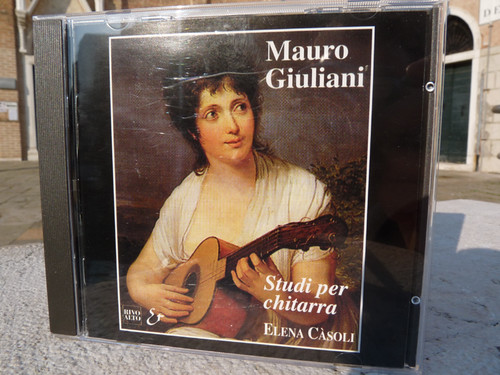
Review of Mauro Giuliani Studi per chitarra by Elena Càsoli (Rivo Alto 1994)


Elena Càsoli Giuliani

Italian Version

In her interview published here on the blog in these days I asked to Elena Càsoli what was hes relationship with tradition and if she played classical pieces in her repertoire. Hes answer showed her relationship with this repertoire in terms of musical and cultural education, showing the link between the study of the tradition and her personal approach to contemporary music. So it’s been with great pleasure that I managed to find this cd made in 1994 with the venetian label Rivo Alto. I think that peple who read this blog (expecially the italian site of Chitarra e Dintorni knows my admiration for the music of Elena Càsoli and therefore will not be surprised by my positive review of this cd. This is an anthology of studies (54 to be exact) featuring the works by Opus 48, 50, 51, 100 and 111 by mauro Giuliani played with great skill and art, 54 musical sketces, musical dreams or dream fragments in sound shape. Elena Càsoli succeeds in creating magical moments of suspension and colorful auroras in which the listener is immersed up, completely loosing himself in the pleasure of the relaxing music by Mauro Giuliani.
I think this is an essential cd for those who plays by themself without a teacher and want to hear a perfect versions of these studies, and a strategically important recording for those who have always seen these musics as simple exercises or borino studies and wants to rediscover them in a new, shining light.

"I think that it’s important to study a particular repertoire or composer, as much as it’s important for every musician to develop an elastic and flexible way of thinking, that shall permit him, to be able to move, I will not say through different styles – an ability that only few artists may have - but through different authors of the same style, enriching their own interpretative perspective and keeping the highest artistic quality." Elena Càsoli

venerdì 7 settembre 2012

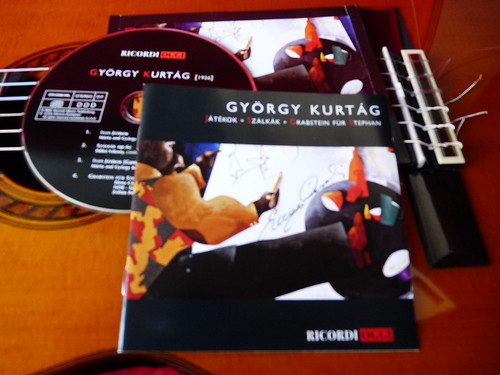
Review of Játékok; Szálkák; Grabstein für Stephan by György Kurtág, Stradivarius


Kurtag

Italian Translation

Beauty is to me an extremely difficult thing to define .... with a certain objectivity. Beauty and the taste of the observer appear to be two inseparabile things, two sides of same coin, thinking about beauty completely independent by the eyes of an observer ... it's like to think about a piece of art, a wonderful score, which is jealously guarded inside a safe and that nobody will be able to play.
I believe that the quest for beauty leads to the cognition of objects as having a certain intrinsic or extrinsic harmony with nature, which inspires a sense and an experience of attraction, affection, pleasure, health. I think that it might be the case of this record where we can listen to new, fresh, original music, far from certain aspects of perfectionism in itself. This is a record of priceless beauty that brings together a selection of educational Játékok (Games) played by Kurtág himself with his wife, a magic piece for the Cimbalon played by Ildikó vékony and Grabstein für Stephan for classical guitar and other instruments, soloist the excellent Elena Càsoli
Játékok (Games) is not a method for studying piano designed for young learners, but a work that, as the contemporary Hungarian composer said: "suggested by the child who forgets about himself while he plays, that child for whom the piano is still a game.” This is a work that starts by the observation of children's experiences around the music and trying to exorcise these experiences through the recovery of the memory of the trauma of those who approaches to music when they are still young. Szálkák is dedicated to the musician Martha Fabian, who had great influence not only on Kurtag but also on other Hungarian musicians, it’s a work for cimbalon, the Hungarian dulcimer, while Grabstein für Stephan, for guitar and groups of instruments, is a unique piece in a single breathing, characterized by a remarkable dynamic, a " musical tombstone where the guitar of Elena Càsoli plays a frame with simple and linear arpeggios with the other instruments, in a highly emotional enviroment. What shall I say more? Please, give up yourself to this beautiful music.

sabato 1 settembre 2012

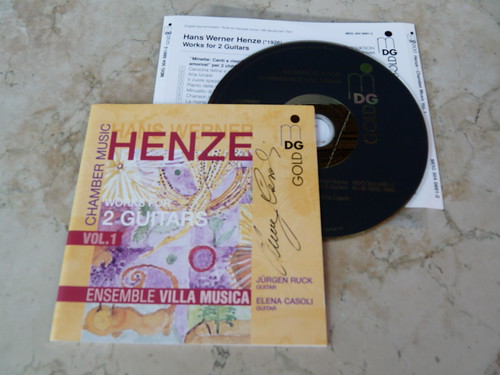
Review of Hans Werner Henze – Works for 2 guitars by Elena Càsoli and Jurgen Ruck, DG 1999


Elena Càsoli Jurgen Ruck Henze

Italian Translation

First confession: I bought this cd by impulse, during a night raid on the web. I have to say that this was the first time I heard the beautiful music of Hans Werner Henze, I didn’t know his music before and I knew Jurgen Ruck indirectly because I knew he’s the guitar player of the Modern Ensemble and I have their records with Zappa’s music. Second confession: listening to this cd proved to be simply a pleasant surprise, it's nothing but excellent with a wonderful dynamic and the performers are simply brilliant, two guitars that fit perfectly with each other showing a variety of colors and cromatisms.
The listening shall be a little hard, it’s like a meditation, you have to sip it, to savor carefully listening to it again and again, allowing the music to absorb yourself, a music that never disappoints, never. The CD is divided into three parts. The first one is devoted to trascription for two guitars of The English Cat, now renamed with the name of the protagonist “Minette:Canti e rimpianti amorosi”. The story is about Minette, a young kitten in the countryside, going to town, to London to marry Lord Puff, the President of the Royal Society for the Protection of Mice,and falling in love with Tom, until the sad epilogue when she dies, submerged in the Thames. This music is made with seven movements, almost with a folk feeling, where folk means naturalness, spontaneity, authenticity and deep expressivity. The beginning is sunny, almost bucolic becoming gradually more melancholic, gloomy, as illusions vanish and the hardness and cynicism of the world take over. The guitars vibrate, dance with elegance, are almost feline in their expressions, calling the movement and the games of cats. "Memorias de El Cimarron for two guitars" reflects the figure of Henze as "homo politicus". Composed in 1995 through collaboration with Elena Càsoli and Jurgen Ruck, has his reference in El Cimarron - Recital for Four Musicians, a composition written in Cuba in 1969/70, based on the history of slave Esteban Montejo told by Cuban writer Miguel Barnet . Influenced by the ideals of the Cuban revolution, this work gives freedom to his player, giving the feeling that even in the Memorias where music, freed from the singing parts and rearranged for two guitars, shines for the continual exchanges between the guitars, the continuous changes of rhythm, the short improvisations and the percussive use of the instruments by the two interpreters. The work "Pollicino" was written between 1979 and 1980 for the children of the town of Montepulciano in Tuscany. This tale has been transformed into three movements for guitars that tell, simply and calmly, that dear old fairy tale. As i wrote before, this is an excellent cd, an impeccable recording, published as cd gold and accompanied by a beautiful 32-page booklet written in three languages: English, French and German. Get it. You will not regret it.